























Written by Jenny Brhel, Nebraska Extension Educator

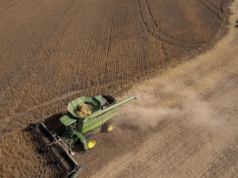
With harvest ramping up this week, wishing you safety and a good harvest! Make sure to think fire safety and also take care of yourselves emotionally, mentally, and physically. Taking breaks will be important, especially when harvesting this storm-damaged corn, but also because of the stress many are facing.
Watch crop harvest moistures: I mentioned the importance of watching soybean moisture last week and checking soybeans when there’s still some leaves remaining on plants in spite of green stems. We updated this CropWatch article last week https://go.unl.edu/dzb4 and added a table to better visualize what’s being given up in gross by selling soybeans above and under 13% moisture.

Corn is also drying faster than what one may realize, especially after this weekend’s hot temperatures and because of the amount of late-season disease. I’ve been asked what to expect for dry-down for those using storm-damaged corn for high-moisture corn and/or silage. Upon reaching physiological maturity (black layer), most corn hybrids are around 30% moisture. The average corn dry-down for hybrids reaching maturity in late August is around 0.8 percentage point per day and 0.4 percentage point per day for hybrids reaching maturity in mid-September. High heat and wind, such as we experienced last year in September 2024, can lead to well over 1.0 percentage point per day in dry down.

Accelerated senescence and grain drying of corn can also occur with the hail damage and lodging in addition to high amount of late-season southern rust and tar spot this year. One can easily observe hybrid differences in how they’ve reacted to southern rust. Sometimes these pressures lead to the premature death of plants, including the premature formation of a black layer. When that happens, grain drying occurred earlier than anticipated with a higher dry-down rate per day than if the grain had matured normally.
Corn hybrid characteristics can also impact kernel moisture. Hybrids that have thinner or permeable pericarp layers (outermost layer of the corn kernel), are more subject to moisture loss and faster drying rates in the field. I’m unsure how one knows this characteristic though. Other characteristics resulting in quicker dry-down include: lower husk leaf number and thinner husk leaf, how soon the husk leaf tissue turns brown, how well the husk covers the ear (less coverage allows for faster drying), how tight the husk is (as looser husks will increase moisture loss), and how fast the ear turns down vs. remaining upright.
My concern, particularly in the non-irrigated fields, storm-damaged, stripped-up corn, and corn heavily impacted by southern rust in the area I serve, is that corn is actually drier than one may realize. Apparently, this concern also exists in Indiana, as Dr. Bob Nielsen, Professor Emeritus from Purdue University, released an article last week on avoiding selling too dry of corn to the elevator: https://www.agry.purdue.edu/ext/corn/news/timeless/WaterShrink.html.
Alfalfa and Wheat Expo: Nebraska Extension is hosting the 2025 Southeast Nebraska Alfalfa & Wheat Expo on Friday, Sept. 19, from 8:30 a.m. to 3:30 p.m. at the Saline County Fairgrounds Office (1600 Tuxedo Park Rd., Crete). This one-day event is designed for wheat and alfalfa producers to gain practical insights, connect with experts, and sharpen their management strategies. Topics include: Equipment considerations for wheat production; Wheat disease updates and management strategies; Insights on achieving high-yield wheat in southeast Nebraska; Alfalfa irrigation, insects, weeds, and crop health management; Pesticide safety updates; Sponsor exhibits, networking, and raffle prizes. Come for the whole day or stop in for the sessions that fit your schedule. Register online at https://go.unl.edu/2025-alfalfa-wheat-expo or call the Saline County Extension office at 402-821-2151.