




























Summer is ending, and fall is just around the corner. To quote Galadriel from The Lord of the Rings, “The world is changed. I feel it in the water. I feel it in the earth. I smell it in the air.” Pivots, having served their vital purpose of providing life-giving water, now stand still, their relentless and monotonous orbits finished. Plant life—so lush and green—corn and soybeans included—is dying, filling the cool air with those familiar scents we associate with the start of fall—and the harvest. Days are getting shorter as they rush toward the Winter Solstice. Temperatures are dropping, daylight is shrinking, shadows are lengthening—and Hobby Lobby is decked out for Thanksgiving and Christmas.
On the home front, kids are back in school, the gridiron is energizing Friday nights, the marching band is drilling on Main, the fair season has come to a close, and Husker Harvest Days are approaching. Farmers are preparing for harvest, making last-minute repairs to their equipment and readying their facilities for this year’s crop.
Not surprisingly, the idea of harvest appears prominently in Scripture. Set against the backdrop of an agrarian culture, many Bible stories focus on the cycle of planting and harvesting. Jesus’ parabolic, short story style of teaching drew on this world. And so, “A farmer went out to sow his seed… (Matt 13:1-43). “For the kingdom of heaven is like a landowner who went out early in the morning to hire men to work in his vineyard…” (Matt 20:1-16). “There was a landowner who planted a vineyard… When the harvest time came, he sent his servants to the tenants to collect his fruit…” (Matt 21:33-46).
The Apostle Paul also utilized the motif of planting and harvesting. Perhaps the most well-known passage is in his letter to the Galatians:
“Do not be deceived: God cannot be mocked. A man reaps what he sows. The one who sows to please his sinful nature, from that nature will reap destruction; the one who sows to please the Spirit, from the Spirit will reap eternal life. Let us not become weary in doing good, for at the proper time we will reap a harvest if we do not give up. Therefore, as we have opportunity, let us do good to all people, especially to those who belong to the family of believers.” (Galatians 6:7-10)
According to Paul, only the self-deceived believe we can avoid harvesting what we have sown. The process of sowing and reaping is clearly observable and rational. The natural laws God established to sustain His creation demonstrate that sowing and reaping are fundamentally connected. If corn is sown, corn is harvested; like produces like. If one kernel of corn is sown, an ear of corn is reaped; what is sown multiplies. When corn is sown in spring, it is harvested later in the fall; the harvest comes after a season of toil and growth. Sowing and harvesting are embedded in the DNA of God’s universe.
What is true in the natural world is also true in the spiritual realm. Paul makes this connection clear: investing our time and energy to please our sinful natures will lead to destruction—it can’t be any other way. Like produces like. Conversely, a life surrendered to the Spirit yields a harvest of eternal life—the abundant life here and forever. What is sown multiplies exponentially—good or bad! The prophet Hosea warns, If you sow the wind, you’ll reap the whirlwind (8:7).
Having established the principle of spiritual sowing and reaping, Paul drives it home with a direct exhortation followed by an application. Doing good (spiritual sowing) is a Christ-follower’s only reasonable response; we should delight in it rather than being wearied. Let the Spirit produce His fruit of love, joy, peace, patience, kindness, goodness, faithfulness, gentleness, and self-control. Remember, like produces like. But a harvest of goodness is dependent upon persistence. Thus, a good harvest can be compromised or even lost without proper diligence.
Paul’s application to the inviolable laws of the harvest is straightforward and clear: take every opportunity to practice goodness toward everyone, especially fellow believers. Sow goodness—sow to the Spirit. Paul would repeat this message throughout his letters. “Make sure that nobody pays back wrong for wrong, but always strive to do what is good for each other and for everyone else” (1 Thes 5:15) “Be kind and compassionate to one another, forgiving each other, just as in Christ God forgave you” (Eph 4:32).
So, we must ask: what do we gain by withholding goodness from those around us? More specifically, of what value is a dour look, a refusal to smile, a sneer, a snub, a snide remark, or a slanted glance? What seed is being sown? Does anyone benefit? What kind of harvest can be expected? What does an angry look or comment achieve? Put-downs, discriminatory language, sharing hearsay, and personal attacks are seeds sown from our sin nature. They reap destruction. Social engagement, civility, and personal well-being are compromised at every level.
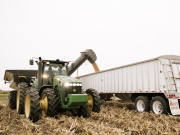
In just a few weeks, combines will march through golden fields harvesting the crops sown months before. Millions of bushels will flow into augur wagons and semi-trucks, destined for markets domestic and foreign, where they will satisfy countless needs. When you see that semi passing you on the road, pause for a moment and reflect: it all started with sowing seeds, nurtured through diligent care. Like produces like. What is sown multiplies. The harvest comes after a season of diligent nurture. We reap what we sow, so let’s not become weary in doing good.