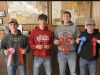
















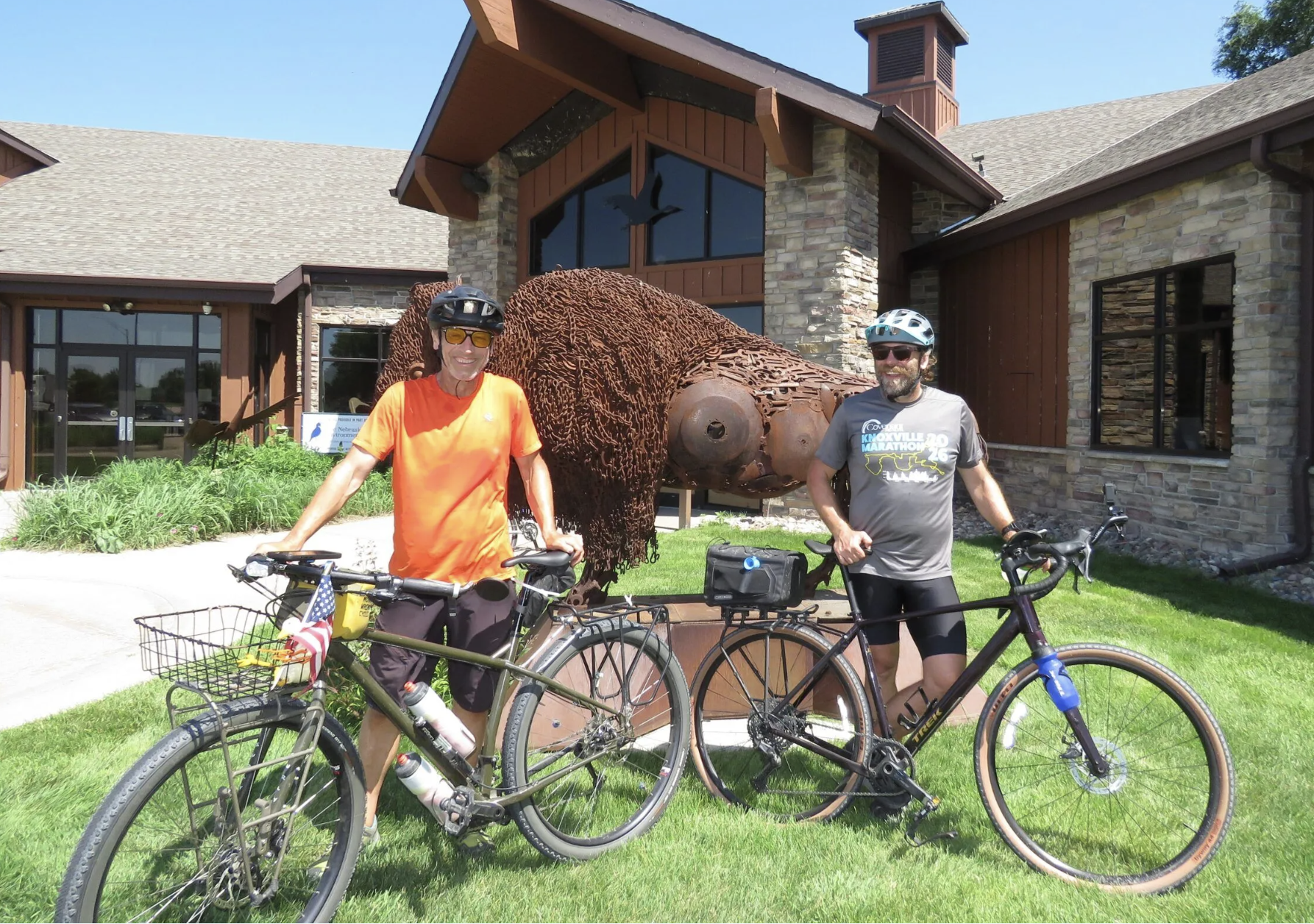
“Pedaling the Whooper Highway” partners Mike Forsberg of Lincoln (left) and Andy Caven of the International Crane Foundation completed a ride from Audubon’s Rowe Sanctuary southwest of Gibbon to the Crane Trust visitor center near Alda on June 5. They recently completed a 50-day, 2,500-mile bicycle journey along the Central Flyway. Photo courtesy of Lori Potter

Renowned nature photographer Mike Forsberg and a leading crane scientist biked the Central Flyway migratory route for science — and to promote conservation efforts for the endangered whooping crane.
Written By Lori Potter
Mike Forsberg thought he knew the Great Plains. The renowned conservation photographer felt a familiarity with the land, having dedicated decades to documenting the fragile ecosystem.
Now, though, the Nebraska native has a new perspective, thanks to a grueling two-month bike ride following the Central Flyway migration route used by endangered whooping cranes each spring and fall. Forsberg, alongside conservation colleague Andy Caven from the International Crane Foundation, completed the 2,500-mile journey from Texas’ Gulf Coast to central Saskatchewan in Canada Tuesday.
“On bikes, you’re a lot closer to the land, and all of your senses are engaged,” Forsberg said during an early June stop in Nebraska. “In a vehicle, you can’t hear it, you can’t smell it, you can’t even taste it, and we’ve eaten a lot of bugs.”
The two came up with the project, dubbed “Pedaling the Whooper Highway,” back in December to help inspire conservation efforts for the rarest and largest of the world’s 15 species of cranes. Today, there are an estimated 835 whooping cranes — approximately 550 in the wild — up from a low of 15 migrating whoopers in the 1940s.
Despite their endangered status, many people living along the Central Flyway know little about them and even less about their migrations and habitats, Forsberg said.
The bike ride wasn’t the first time Forsberg and Caven, who served as the Crane Trust’s director of conservation research in Nebraska from 2015-2022, collaborated to raise awareness about crane conservation. The spent eight days in side-by-side blinds in northern Canada to document whooping crane chicks hatching in 2023.
Forsberg also traveled the Central Flyway in 2022 in an airplane, which provided a “like a bird” experience far different from this spring’s close-up views.
They started pedaling May 11 in Texas’ Aransas National Wildlife Refuge and headed north. They didn’t take the advice to spend a year planning the trip.

“The first day out the door, your plan can change,” Forsberg said. “So it’s sort of like the birds deciding when to leave and then just go.”
Caven, who grew up in South Dakota and now serves as the Central Flyway programs director at the International Crane Foundation, said they identified 44 potential stops — important habitat sites for whooping cranes — ahead of time, knowing that weather, detours and other factors might limit their travels.
Pedaling project
The pair met some storytelling goals by inviting other cyclists to join the ride along the flyway. On June 5, 23 people biked with them for 25-plus miles along the Platte River from Rowe Sanctuary to the Crane Trust.
That area is the migration route’s halfway point in miles — actually 46.3%, according to Caven, the scientist.

Caven and Forsberg averaged about 55 miles per day at speeds of 8-20 mph. Forsberg’s Surly ECR bike and Caven’s Trek Checkpoint are designed for traveling gravel roads and “bikepacking.”
At least one person was always with them in a pickup truck carrying food, water, first aid and bicycle repair supplies. The support vehicle crew also helped monitor weather conditions and plan daily routes.
Overnight stays were at campgrounds, motels and places like Rowe Sanctuary and the Crane Trust.
Most crew members were staff for the Platte Basin Timelapse project co-founded by Forsberg in 2011 and headquartered at the University of Nebraska-Lincoln. Several staff members traveled with Forsberg and Caven to gather documentary video and photos.
Forsberg, for his part, couldn’t carry his normal camera equipment. His only gear: an iPhone, on which he got a crash course from longtime National Geographic photographer Jim Richardson beforehand.

“It’s not easy. It hurts. You get sore,” Forsberg said about long bike rides. He noted that Caven could ride faster and farther. “I really start to seize up at about 60 miles. I think of us as like a couple of whooping cranes traveling together … They’re not in the same fitness level either.”
Caven joked that preparing to ride each morning required several cups of coffee and lots of Tiger Balm.
He documented conditions in Central Flyway habitats. By June 4, as the duo was making their way through Nebraska, he’d already identified 150 bird species and 300 plant species.
Caven described whooping cranes as an “umbrella species,” which indicates habitat qualities also important to other species. Conservation that helps an umbrella species can benefit others.
Along the way, he and Forsberg talked to people in small towns about the Great Plains natural resources around them.

“So far, we’ve never talked to anyone who was angry,” Forsberg said in early June. “Maybe they were indifferent at first, but they’ve all been proud of where they live.”
Aside from education, Forsberg had another goal: identify a flyway touring route for others to follow. Forsberg knows of many U.S. trails built around landscapes or history, but none defined by a migration.
Bigger picture
“Pedaling the Whooper Highway” joins a long list of efforts to learn more about cranes and their habitats and tell those stories. Each is like an addition to a Great Plains/Central Flyway quilt.
In addition to the Platte Basin Timelapse, Forsberg’s storytelling projects include books and “Follow the Water,” a Nebraska Public Media documentary that follows Forsberg and filmmaker Pete Stegen as they travel the Platte River from its Wyoming headwaters to the Missouri River.
For 50-plus years, International Crane Foundation co-founder George Archibald and his staff have studied cranes in captivity and in remote places around the world. “Pedaling the Whooper Highway” provides an opportunity to educate people living the Central Flyway on important conservation issues, including the safe placement of wind turbines, which can kill migrating birds.
“Although the major wetlands where whooping cranes rest during migration are protected, there are hundreds of smaller wetlands that also provide important habitat for the cranes but are now disappearing through reduced rainfall as a consequence of climate change,” he said.
Passion project
“Pedaling the Whooper Highway” is one of Mike Forsberg’s several long-distance, fact-finding, storytelling journeys.
In 2011, he and Nebraska Public Media veteran Michael Farrell co-founded the Platte Basin Timelapse project based at the University of Nebraska-Lincoln School of Natural Resources. Cameras at 70-plus sites take one photo every hour of every day from sunrise to sunset.
Camera equipment has been upgraded over the years, said Grace Carey, Timelapse outreach and education coordinator. Only two original locations remain, but most newer cameras are near original locations.
There are now more than 5.2 million images and 180-plus stories, according to the Timelapse website. Carey said anyone can use the content for research, education and storytelling.
The Timelapse project played a key role in Forsberg’s 2016 hiking, biking and canoeing journey with videographer Pete Stegen to track an imaginary drop of water 1,350 miles from the Platte’s western Wyoming headwaters to the Missouri River at Plattsmouth, Nebraska.
That story was told in the documentary “Follow the Water.”
Forsberg has been featured in other crane or Great Plains documentaries. His books include “Ancient Wings – The Sandhill Cranes of North America,” 2005; “Great Plains: America’s Lingering Wild,” 2009; and “Into Whooperland,” 2024.
Forsberg said he felt the weight of migration while on the road and gained a better understanding of how whooping cranes must adjust to day-to-day conditions. “You just think about what’s ahead of you, that day, that morning, that mile,” he said.
Caven recalled how early in their journey he heard only eastern meadowlarks. When they crossed into Kansas, they heard their first western meadowlark, then a mix of both. Soon, there were only western meadowlark songs.
“One of the wonderful things about the natural world is it can make you feel small,” Caven added. “I love that, but others may not.”
Heading home
With the trip complete, the two will focus on homework. Caven has a deadline to send a draft report to the North American Crane Working Group. Forsberg will organize iPhone photos and videos.
The travelers have just begun to put their experiences into words.

“The Central Flyway through the Great Plains and North America is an incredibly diverse landscape. It has incredibly diverse wildlife and incredibly diverse people,” Forsberg said.
“I wish everybody could see the beauty of what a well-managed grassland can provide in terms of bird habitat,” Caven added before listing off other, more common birds that call the Central Flyway home. “They’re very important to the whooping crane, but most people never see whooping cranes.There is a lot of other bird life people can see, if they were interested.”
The word “grateful” comes up a lot.
“I feel a tremendous gratitude to be able to do something like this with a team of people that are so wonderful and important in my life. … I’m glad my body survived,” Forsberg said. “I’m not sure if my mind has.”
The journey proved a “privileged experience,” Caven said. “Very few people have had the opportunity to take in something so granularly. It felt like I got a two-month snapshot of the current state of the Great Plains and I’ll never get that again in the same way.”
It might not be the pair’s last Great Plains adventure, however. “We have layers and layers of more good project ideas,” Forsberg said. “It’s about finding the time and the timing to use them.”