

























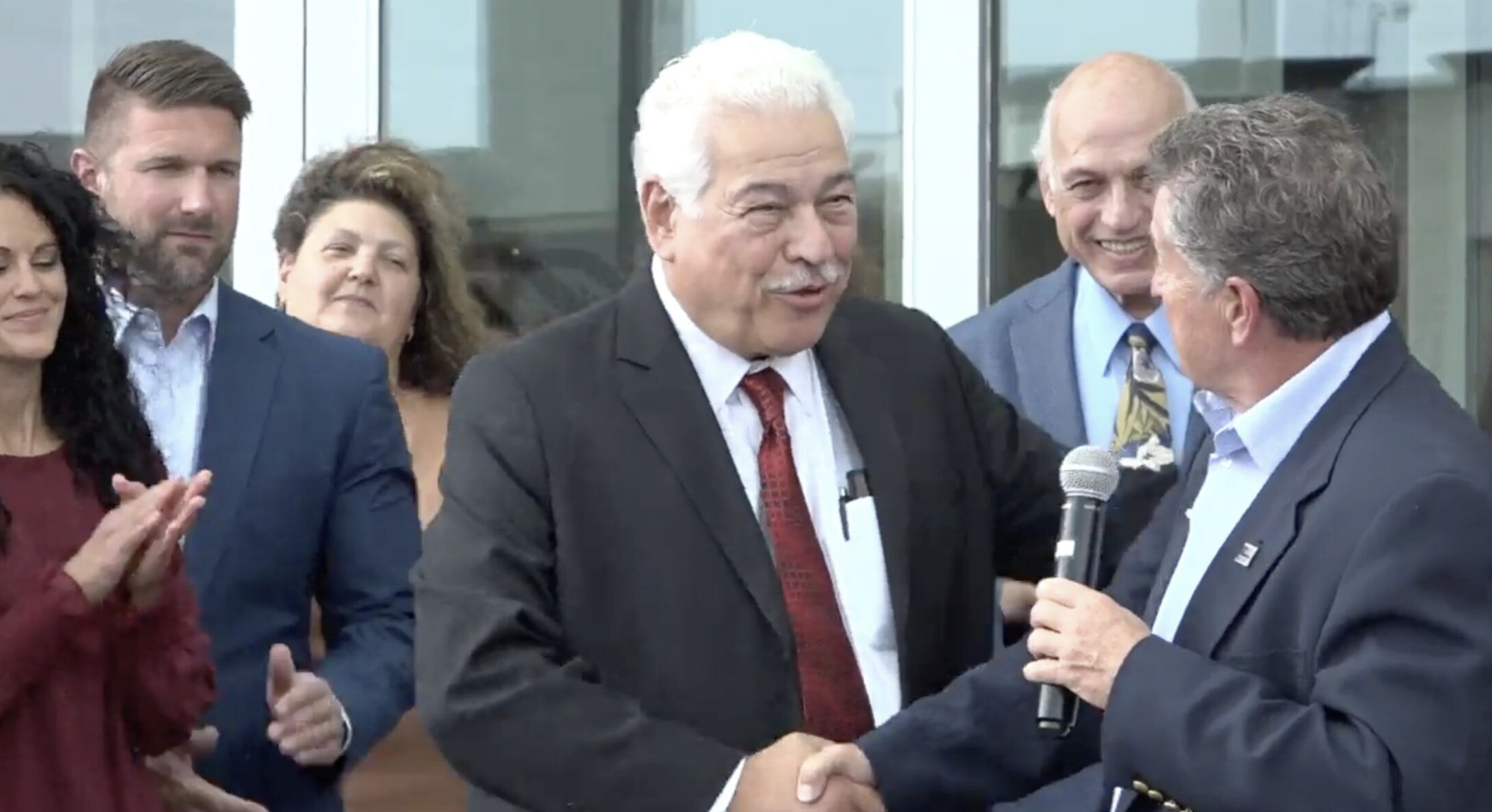
Developer Paul Younes shakes hands with then-Mayor Stan Clouse at a 2022 event in Kearney. “Paul got to where he’s at by hard work, not by cheating the system,” said Clouse, now a state senator. His comments came following news that the federal government wants Younes to testify in an investigation looking at potential fraud. Photo courtesy of News Channel Nebraska
They’re investigating whether the Younes family’s businesses improperly got $4.6 million in COVID business loans. The family’s lawyer says they have been cooperating, but they now want a judge to stop the investigation.

Written By Sara Gentzler and Emily Wolf
KEARNEY — Few figures loom larger here than Paul Younes. The heart of his central Nebraska hotel empire stands just off Interstate 80 — a sprawling, modern campus filled with trendy businesses and sleek buildings. The family name adorns multiple conference centers, even a street sign.
Now, it also appears in a federal court filing, alleging Younes and two family members have stonewalled federal authorities investigating whether the family’s businesses improperly obtained over $4 million in relief funds during the COVID-19 pandemic.
The Youneses’ lawyer, Mike Duffy, said in a statement that the family consulted with experts in order to properly apply for the money. They have cooperated with investigators for years, he said, but are now fed up with the feds’ “frivolous investigation” and want a judge to call off the chase.
Most community leaders who spoke with the Flatwater Free Press weren’t familiar enough with the current court drama to comment on it. But each person extolled the family’s reputation and influence in Kearney.
“Paul got to where he’s at by hard work, not by cheating the system,” said State Sen. Stan Clouse, who was the central Nebraska city’s mayor for almost two decades.
Paul Younes’ story fits squarely in the archetype of the American Dream.
He came to the U.S. from Israel in the 1970s to go to college in York before transferring to what was then Kearney State College. His first job: washing dishes at The Lodge Restaurant. The Youneses declined an interview request for this story via their attorney but confirmed biographical information.
The young Younes worked his way up the ranks at local hotels and eventually started managing them. He married Linda, who was a housekeeper from Loup City, and they had two children. He started welcoming family members from overseas to join them in Kearney.

Today, the family operates 14 hotels and three conference centers across Kearney, Grand Island and Hastings. They have a reputation for treating employees well. Community leaders pointed to affordable housing Younes provides on campus and said he’s frequently seen serving alongside his employees at events.
They’re also prolific local philanthropists: “You name the capital campaign in Kearney, they’re involved,” said former Mayor Pete Kotsiopulos, who said he has known Paul Younes for over 50 years.
“Paul might be the most well-known person in town and the most-liked person in town,” said current Mayor Jonathan Nikkila. “How often do you hear that about a developer?”
But for at least two years, as Younes has accepted a tourism award and continued to make plans to develop the area, his family has been at the center of a federal investigation.
The Department of Justice’s inquiry appears to tie back to the patriarch’s years-old conviction for employing a Mexican woman who wasn’t authorized to work in the U.S. In that case, federal prosecutors charged that in late 2014 and early 2015, Paul Younes hired her knowing she wasn’t authorized to work and employed her multiple places under different names.
As part of a plea deal, Paul Younes was sentenced to five years’ probation in 2016 and had to pay a $3,000 fine.

Four years later, during the COVID-19 pandemic, the hospitality industry was among the hardest hit. The family’s businesses applied for, and obtained, more than $4.6 million in Paycheck Protection Program loans from the federal government.
At the beginning of the Paycheck Protection Program, if someone with a felony conviction from the past five years owned 20% or more of the applying business, it was ineligible for aid. The business was similarly ineligible if someone on probation or parole owned 20% or more of its equity. Those rules were later modified to allow greater eligibility.
Since at least 2024, the government has been investigating whether Younes businesses “fraudulently obtained” those loans and their forgiveness since Paul Younes was on probation when the applications were submitted.

According to a letter submitted as part of the federal government’s case, Paul Younes transferred his ownership to Linda before applying, based on an attorney’s advice. That attorney has testified as part of the investigation.
“(The) Younes(es) clearly did not intend to defraud anyone in their application; rather, they intended only to comply with the law to save hundreds in their community from unemployment during a difficult and unprecedented time,” the letter from Duffy to federal prosecutors reads.
The family’s lawyers have argued that current information, including written answers from the Youneses, is enough for the DOJ to end its investigation. Duffy also offered limited interviews instead of broader depositions, according to court documents.
But federal lawyers insist that the testimony of three of the companies’ leaders — Paul and Linda Younes and their daughter, Margarita Younes-Holz — is critical to the investigation and to evaluating the defense that they were following the advice of professionals. The Youneses have given several invalid reasons for not complying, they wrote in an email that’s now part of the case, including at one point asserting their Fifth Amendment rights. Federal attorneys on the case did not respond to an interview request.
“It is not unreasonable for the United States to expect the three individuals responsible for obtaining over $4.6 million in loans and forgiveness from the United States to provide testimony regarding the applications and eligibility for those funds,” government lawyers wrote.
Duffy said they plan to file a response within 60 days.

Trevor Lee, who leads the Development Council for Buffalo County and once worked for Younes, said recent court activities haven’t changed his perspective on the prominent family, and he’d imagine “the vast majority of folks in Kearney feel the same way.”
Lee provided data showing the impact of Kearney’s “hospitality district,” which is mostly Younes’ properties.
That area sees 578,000 visitors annually, and 79% of visits come from outside Kearney ZIP codes. It spurs $173.9 million in annual visitor spending, and 1,300 tourism-supported jobs, his data show.
“They’ve made Kearney what it is today,” Lee said.
Paul Younes donated the land next to the Interstate, near several of his hotels, that’s now the massive, city-run Kearney SportsPlex. The Kearney Welcome Center sits nearby on Younes-owned land, which he leases for a nominal amount, according to local leaders. And he developed more of that area, which now features a golf and pickleball complex, a brewery, restaurants and more.
He prioritizes the community in his development decisions, multiple leaders said, and that commitment separates him from the typical developer.
“Everything that he does, I truly believe he does with the lens of: This will be good for their business, but also this will be good for the Kearney community, for central Nebraska and for the state as a whole,” said City Manager Brenda Jensen.
In May, voters overwhelmingly approved a 200-acre Good Life District — one of five in the state — where the city can collect 50% of the state sales tax from the district to reimburse the developer for some costs. The developer envisions housing, retailers and more.
That developer, in Kearney, is Paul Younes.