























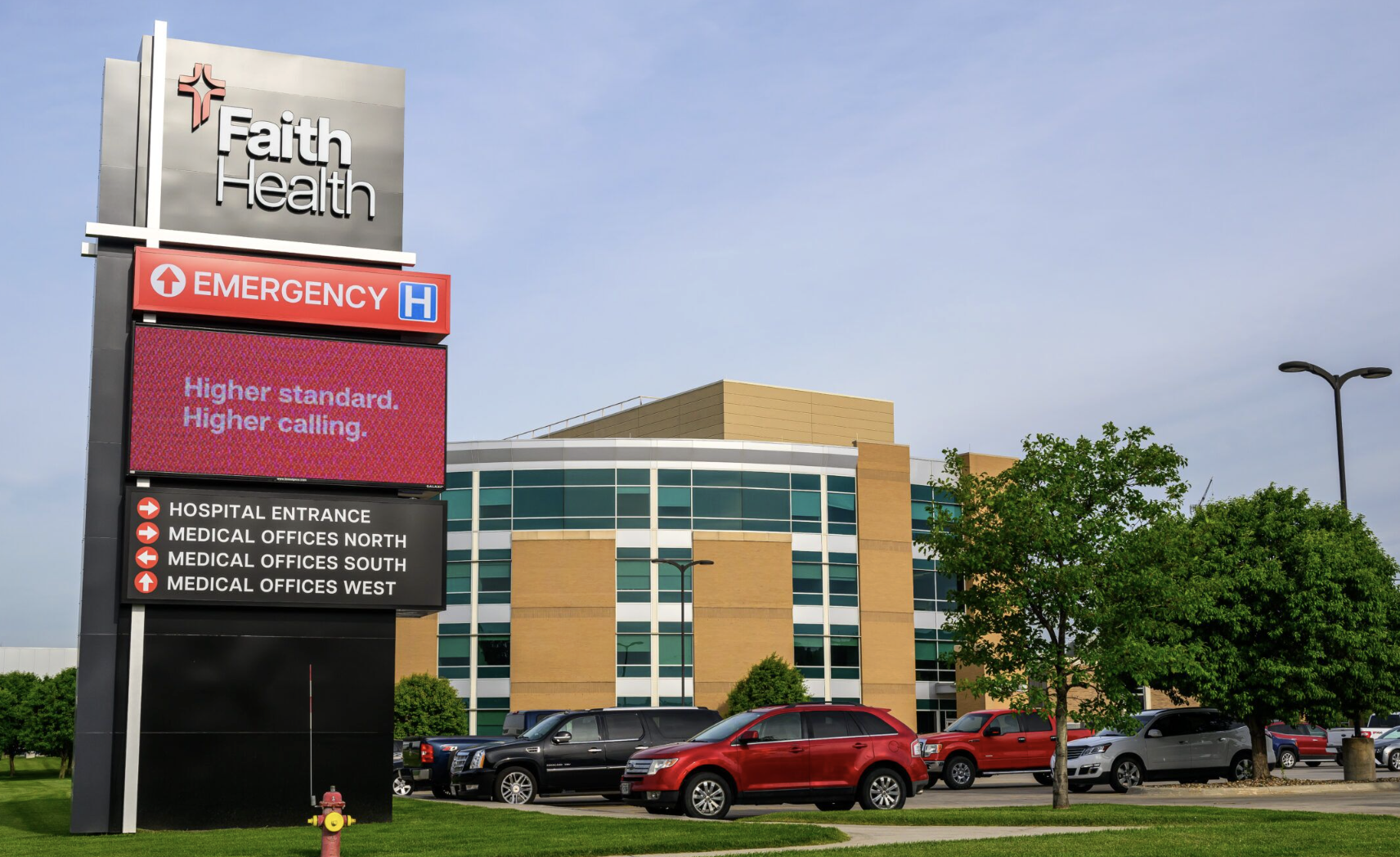
Faith Health in Norfolk, formerly known as Faith Regional Health Services, paid its gastroenterologist nearly $5 million in 2024, according to public tax documents. The same nonprofit hospital paid a plastic surgeon $3.8 million. The two doctors were the highest-paid employees of any Nebraska-headquartered nonprofit that year, according to an online database. Flatwater Free Press photo

Written By Sara Gentzler
A gastroenterologist who worked at Faith Health in 2024 made nearly $5 million, while a surgeon there made nearly $4 million. The two highest-paid nonprofit employees in the state benefit from a bonus system criticized for incentivizing more medical procedures.
Nebraska’s state auditor calls it inexplicable. A former health insurance CEO suggests it’s excessive. A veteran doctor says it’s unheard of.
They’re reacting to what a nonprofit hospital paid its gastroenterologist in 2024: Nearly $5 million, according to public tax documents. That same hospital, Faith Health in Norfolk, paid a plastic surgeon $3.8 million.
Those sums made the doctors the two highest-paid employees of any Nebraska-headquartered nonprofit that year, according to an online database.
Most of their compensation came from bonus and incentive pay, at least in part determined using a commonly used calculation that is often criticized by doctors and others for rewarding more procedures. In the case of the gastroenterologist, who no longer works for Faith, a former patient told the Flatwater Free Press that he felt the doctor had performed an extra procedure without his permission.
Hospital leaders declined interview requests and did not answer specific questions emailed to them. In a statement, Chief Operating Officer Brian Blecher said that it’s challenging to recruit and retain doctors in Norfolk, a city of about 26,000 in northeast Nebraska. Faith sets salaries based on data, and physicians can earn bonuses for hard work, like at other hospitals, Blecher said.
State Auditor Mike Foley, whose office has oversight of state payments to entities that contract with the state, including nonprofits, called the gastroenterologist’s pay “eye-popping.”
“I’m not a medical professional, but those numbers just seem extraordinary,” he said. “Inexplicable.”
Foley wasn’t the only one shocked by the numbers.
“They’re a not-for-profit,” said Steven Martin, retired CEO of Blue Cross Blue Shield of Nebraska. “Ask yourself: Isn’t that a little excessive?”
‘The more you do, the more you get’
Matthew Bechtold, who has been practicing gastroenterology in Missouri for over 20 years, said the highest salary he has heard for a gastroenterologist is about $1.5 million. That would be a nationally prominent physician, he said, who does many procedures while hauling in research and pharmaceutical grants.
“I don’t ever hear of $5 million in our field,” Bechtold said.
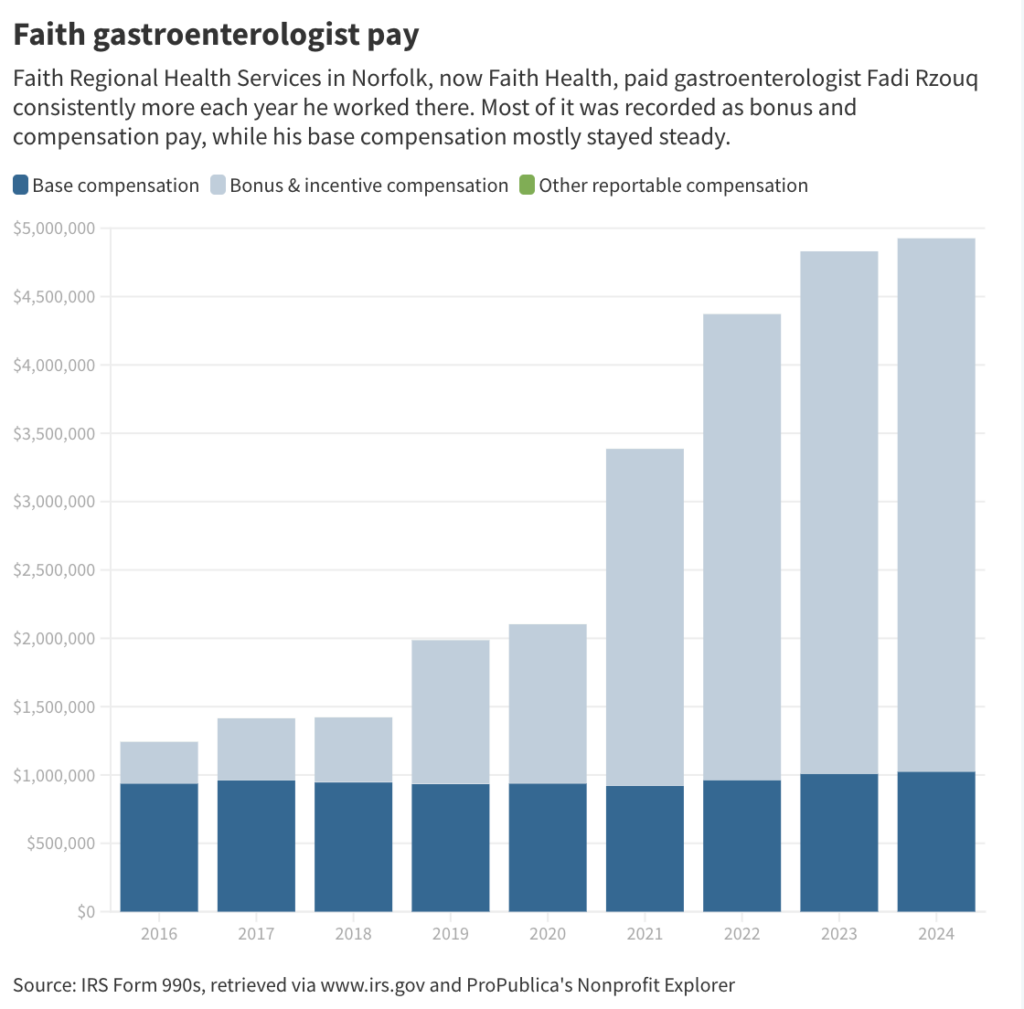
Faith Regional Health Services, which recently rebranded as Faith Health, paid Fadi Rzouq $4.9 million, according to the Norfolk hospital’s most recent tax filing. The figure doesn’t include retirement and other benefits. He had made more than $3 million each year since 2021.
Rzouq is board-certified in gastroenterology. He went to medical school in Jordan, the University of Washington for his residency and secured two fellowships at the University of Kansas Medical Center, according to his profile for the clinic in Texas where he’s now listed as on staff. His specialties include pancreatic, upper gastrointestinal and liver diseases.
“Good medicine begins with trust, compassion and taking the time to truly listen to patients,” he’s quoted as saying.
Rzouq owns a house in Norfolk that is currently on the market for $2.6 million. Reached by phone, Rzouq declined an interview for this story.
Faith’s tax filing shows $3.9 million of Rzouq’s pay — about 79% — in 2024 came from bonuses and incentives.
The filing also notes that physicians’ “production bonuses” were tied to relative value units — part of a system that helps the federal government and insurance companies define the worth of a physician’s work. A procedure, for example, has a higher RVU than an office visit.
“Physicians have an opportunity to earn production bonuses if the provider reaches above relative value unit amounts,” the tax filing reads, and payouts depend on the doctor’s base salary.
Rzouq was listed among five Faith physicians who earned those bonuses in 2024.
It’s typical for a hospital to set a quota for a doctor — say, 1,000 RVUs — and figure bonuses based on the surplus number of RVUs they actually tally, said Bechtold, the Missouri-based gastroenterologist. RVU-based models can encourage a doctor to do more and more procedures, said Bechtold and former insurance CEO Martin.
“There is an incentive in specialty medicine,” Martin said. “Income can be increased by doing more procedures. In other words: The more you do, the more you get.”
Rzouq’s $5 million is indeed “well above the norm” and “significantly higher than the revenue a single gastroenterologist would be expected to generate for a hospital,” said Lawrence Kim, past president of the American Gastroenterological Association Institute.
“That amount of volume is relatively unheard of — to make that many RVUs, to get that type of bonus,” Bechtold said.
Kim said he suspects Rzouq had responsibilities beyond direct patient care. Flatwater asked Faith if this was the case but did not receive a response.
Rzouq’s pay wasn’t just exceptional in his field. It also made him the highest-paid employee at any Nebraska-headquartered nonprofit that year, according to a database of tax documents created by the nonprofit news outlet ProPublica.
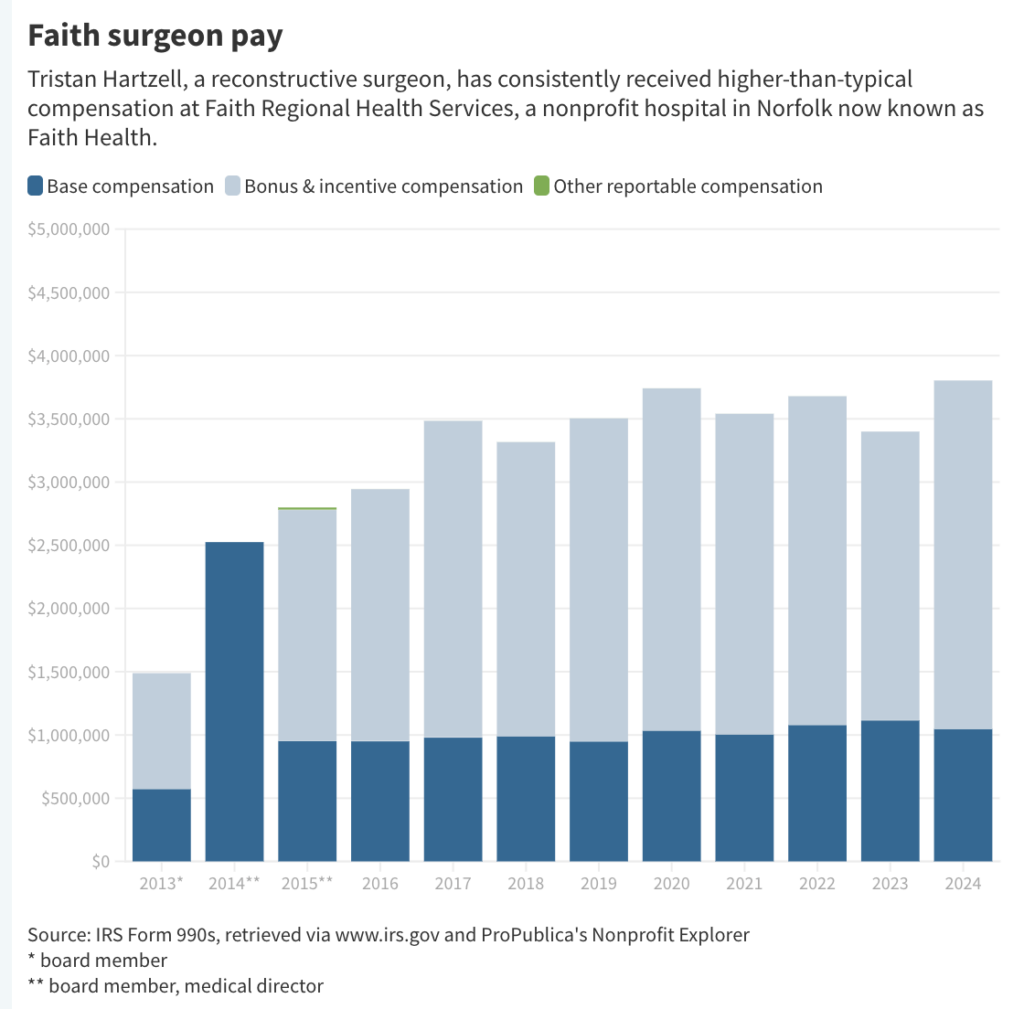
Tristan Hartzell, a board-certified Faith Health plastic surgeon specializing in the arm, was the state’s second-highest-paid nonprofit employee. The hospital reported paying him $3.8 million, including about $2.8 million in bonuses. He was also among the handful listed as receiving a “production bonus.”
Hartzell said in an email that he’s a “highly specialized surgeon” who performs “complex procedures for patients from across Nebraska and around the country.”
He went to medical school at Duke University School of Medicine, did his plastic surgery residency at Harvard, a fellowship at UCLA Medical Center and interned at Massachusetts General Hospital. His biography says that he is “likely the busiest replantation surgeon in the upper Midwest,” and one of a few in the country who perform a specific reconstructive wrist procedure.
He also specializes in treating athletes, according to his bio.
A recent story by Faith Health published in The Norfolk Daily News featured a patient who praised Hartzell’s care and impact on his life.
Three other Faith doctors made over $1 million in 2024, and other doctors from Faith and elsewhere were among the state’s highest-paid nonprofit employees, according to ProPublica. But Rzouq and Hartzell were the only physicians to land ahead of Greg McDermott, then Creighton University’s men’s basketball coach, and James Linder, then CEO of the Nebraska Medical Center.
‘This is what I did’
Ed Nierodzik, Rzouq’s former patient, said he got little face time with the doctor himself. Thinking of his experience with Rzouq still brings up strong emotions.
He’d been bleeding for a week and entered Faith through its emergency room. He stayed in the hospital a week, he said, but saw Rzouq for just a few minutes when he did rounds.
Rzouq stopped the bleeding, Nierodzik said. But he also banded a hemorrhoid, he said, which wasn’t discussed beforehand and hadn’t presented issues.
“There was no, ‘You need to do this, you need to do that,’” he said. “It was simply, ‘This is what I did.’” The experience felt like “This is a way I can rack up a few extra thousand dollars,” he added.
Chronic issues came up after that, making it more difficult for Nierodzik to do things like go to his son’s wrestling tournaments and visit the supermarket. After a year and a half of physical therapy, he said he has finally seen improvement.
When a reporter ran basic information about the procedure by Bechtold, the Missouri gastroenterologist, he said the account didn’t immediately raise alarm.
Tell us about your hospital experience
To inform our future coverage, we want to learn more about your experiences with Nebraska hospitals. Share your experience and let us know if we can follow up.
In another case, the hospital settled a lawsuit in 2021 that alleged Rzouq didn’t do what he should have to manage the care of a 67-year-old man who later died.
The lawsuit alleged that Rzouq didn’t take action to manage the man’s risk for inflammation of his pancreas after performing a procedure and that he failed to give orders for treatment or communicate appropriately with the man and his family as symptoms arose and quickly worsened. The truck driver and dad of two was transferred to Omaha before he died.
Rzouq and the hospital denied the allegations, saying in court filings that the doctor was not negligent during the man’s care and that Rzouq met the standard of care in Norfolk and similar communities. According to court documents, payment of the settlement shouldn’t be interpreted as an admission of liability.
“Dr. Rzouq affirmatively alleges that the medical records speak for themselves,” a court document reads. In another motion, he’s quoted as saying in a deposition that this was the only patient with pancreatitis he had lost in over 10 years.
Lawyers for the patient’s widow asked that the court allow Rzouq’s pay — $1.4 million in 2018 — as evidence. Rzouq was the only gastroenterologist at the hospital and he had taken a second job at a South Dakota clinic for part of the year. A juror might wonder if he was maintaining a grueling workload to pay off crushing student debt, they wrote, or lower their standards for a “simple country doctor” and hospital with limited resources.
“The truth is that Faith Regional has the resources to hire a top-notch endoscopist for elective procedures and to pay him $1,423,308.00 per year,” the lawyers wrote.
By 2024, his compensation was about three-and-a-half times higher than that.
‘An unethical incentive’
Faith, the Nebraska Hospital Association and the AGA all pointed to a fundamental truth that underlies doctors’ salaries: It’s hard to attract physicians to mostly rural areas, and they’re valuable assets to the surrounding area.
“In such areas, hospitals may offer significantly higher compensation than average,” said Kim with the AGA Institute. “This is based upon the physician’s total value to the health system, in order to attract good candidates.”
Those comments align with what Blecher, the hospital’s COO, said in his statement.
“Given the broad reach of our specialty physicians who serve patients not only from Norfolk but also from the surrounding region and neighboring states, it is not uncommon for compensation to be higher than some published salary surveys,” he said.
Other nonprofit hospitals in mostly rural areas of Nebraska paid some physicians in the millions in 2024, though none came close to Faith.
Mary Lanning Healthcare paid a Hastings orthopedic surgeon about $1.9 million, according to its filing. A spokesperson said the surgeon also practiced sports medicine as the sole provider at a practice that had previously spread services among three doctors. Great Plains Regional Health in North Platte reported paying a neurosurgeon about $2 million. Regional West Physicians Clinic in Scottsbluff paid a neurosurgeon about $1.7 million.
The strikingly high salaries in Norfolk raised questions for State Auditor Foley and others.
“If you’re filing a public tax return,” Foley said, “seems like you could talk about: Why is that number so high?”
Nonprofits, including hospitals, are barred from overcompensating employees, said Rick Cohen, chief operating officer of the National Council of Nonprofits, but that definition is “rather loose.” Salaries can pose a challenge for leadership because nonprofits are required to disclose some information but barred from sharing other context for employee privacy reasons, Cohen said.
Martin, the former health insurance executive, said that the situation in Norfolk is indicative of larger issues with the healthcare system that ultimately impact individual patients. One is that a small percentage of specialists account for much of the whole system’s waste and excess care, he said, driving up premiums.
Another is that a hospital can create incentives that enable those specialists.
“In my opinion, that’s an unethical incentive,” Martin said. “If you applied that to another industry, you would find that’s an unethical practice.”