
















Editor’s note: Due to the sheer volume of dialogue and information from Tuesday’s meeting of the York County Commissioners, the coverage of such will be published in installments.
York County Press Release

4/15/2026
Editor’s note: Due to the sheer volume of dialogue and information from Tuesday’s meeting of the York County Commissioners, the coverage of such will be published in installments.
YORK – Even before the York County Commissioners convened for a very long meeting which included public testimony and long discussions about solar zoning in York County, there was a lot to be said.
A number of people who are opposed to large solar projects in York County were outside the York County Courthouse bright and early, holding signs to show their opinions.
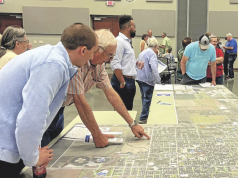
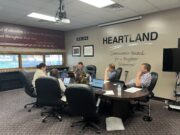
Then, the commissioners’ meeting room filled with interested persons as the commissioners sat down to carve out the remaining points of contention – setbacks for Class 4 (large industrial solar projects).
Before the commissioners carved out those points, a very lengthy public forum was held with many people speaking out against solar projects in York County. (Editor’s note: Those comments will be published in the next installment).
After all the public comment was heard, the five commissioners took votes on nine points of contention regarding setbacks for Class 4 large industrial solar projects. The different setbacks were discussed for front setback on public right of way, non-participating properties, participating dwellings, non-participating dwellings, churches, schools, cemeteries, state recreation areas and platted subdivision.
Commissioner Andy Bowman noted how he felt a 330-foot setback for non-participating properties was “too close. If you farm next to a highway or a place with concrete, you know the impact from the heat.”
“I don’t the evidence shows that,” said Commissioner Joe Burgess.
“As farmer, I can say it is so,” said Commissioner Daniel Grotz, explaining how he farms next to an industrial facility where there is a lot of concrete, “and there is noticeable yield loss near to large areas like that. I know you don’t believe that, Joe, but I’ve seen it.”
“I’ve seen the same by being near the concrete air strip at the airport, it gets hot enough out there to affect even the brome grass on the edges,” Bowman said. “I guarantee 330 feet would affect non-participating fields.”
Commissioner Randy Obermier said he would default to the expertise of Bowman and Grotz as they are farmers.
“There is no evidence it adversely affects neighboring fields,” Burgess continued. “I don’t think there is strong evidence for 330-foot setbacks for non-participating fields.”
For other setbacks, Bowman said he felt there “should be more protections for schools.”
“Protections from what danger?” Burgess asked.
Bowman named numerous things, including the affects of hail storms and tornados if a solar field is nearby.
When they talked about state and NRD rec area setbacks, there were concerns about damage to these types of natural ground should a nearby solar field be destroyed by a tornado, as an example. “If a disaster like that happened by the Kirkpatrick Basin, we would never be able to fix that,” Bowman said. “I am with the zoning board for having half-mile setbacks for recreation areas.”
“When it comes to non-participating dwellings, we have heard a lot of support for half-mile setbacks,” Grotz said.
“That’s too far,” Burgess responded.
“I’m OK with reducing visual impacts, but I think we are so far out of reason with the half-mile,” Burgess added, “as that is a ban, and we’d need a really, really good reason.”
“We do have a good reason, it follows all the other guidelines which were established for setbacks for all other farming/livestock operations in our county,” Bowman said.
“Zoning is a place to minimize the effect on adjoining properties,” Grotz added. “Do you want us to say to people, well you moved here 50 years ago or 10 years ago and you enjoy living out in the country, but now they can put this solar field right up next to you?”
“Even 660 feet is really far,” Burgess said.
“It’s really not, to someone who lives in the country, it’s really close,” Grotz said.
“Well, I guess these are subjective terms,” Burgess said. “You have got to have something as a reason other than visual, and I don’t think heat and flying glass are real concerns. And what’s in the panels, what they are made of, that’s not a real concern either.”
“Who provided you with the model of what is all in the panels?” Bowman asked Burgess.
“I looked it up myself, you can Google it,” Burgess said to Bowman. “We have to recognize what we are regulating here. I can’t think of anything less impactful to live next to.”
“There are still a lot of unknowns about large solar projects,” Bowman said to Burgess. “Joe, here’s a quick history lesson. Round-Up, they said it was completely safe but it caused cancer. There are a lot of unknowns about these large solar projects. I don’t want my kids to have to be sitting here, on this board in 30 years to figure out how to fix a problem I helped create.”
“It’s a mindset thing,” Burgess countered. “I think we are over-complicating what should be a simple thing to regulate.”
“My apologies to the rest of the commissioners that you have to sit through this” conversation, Bowman said.
“Have we depleted this conversation?” Obermier asked, wondering if it was just time to take votes to see where they are for the sake of creating a document (to be considered at public hearing).
The commissioners agreed on a few minimal regulations for battery storage for Class 1 and 2 solar projects. And they agreed, by majority vote, to ban battery storage for Class 3 and 4 projects, with Burgess saying he voted no because “I’m not in favor of banning things in general.” The reason for banning large battery storage at these large solar facilities was due to threats of fire, the other commissioners said.
Then they took on all the different setback distances for Class 4 projects.
The following are the results of those motions/votes. It should be noted that these setbacks will be what will be presented at a future public hearing before the commissioners and the zoning board, to eventually be voted upon for a final resolution.
- Front setback on public right-of-way. The motion was for the setback to be 108 feet.
“I still don’t see what it needs to be further than any building setback,” Burgess said.
The vote: all yes for 108-foot setback, Burgess no.
- Non-participating property. The motion was for the setback to be 330 feet. Burgess said it was too far and Bowman said was too close – both voted no. The others voted yes.
- Participating property. The motion was for 75 feet. All voted yes.
- Non-participating dwelling. The motion was made by Bowman for 2,640 feet (half-mile).
“I understand your stance, Andy, I do,” Obermier said. “I’d go up to a quarter-mile for homes completely surrounded. I still think half-mile is too far but I’ll give your motion a second to get it to a vote.”
“The people who have been showing up here, today and again and again have been for the half-mile setback for non-participating dwellings. And they have been saying so because they are trying to protect the properties,” Bowman said.
Commissioner Deb Robertson said she needed to simply ask one question, “Then do we even want to allow solar projects of this size in York County? I have to ask.”
“I’d rather ban them, but I think the setbacks are more feasible in the court of law,” Bowman said. “The half-mile setback doesn’t disallow these project, it just follows the same setbacks that have been created for other endeavors like livestock production.”
“I don’t think the half-mile setback is appropriate,” Burgess said. “If the intention is to ban then, then we should just ban them.”
The vote was taken on the half-mile setbacks for non-participating dwellings. Bowman, Robertson and Grotz voted yes with Burgess and Obermier voting no.
- Bowman proposed half-mile setbacks for churches and schools. Voting yes were Bowman and Grotz with the other three voting no, so that motion failed.
In a new motion, Obermier made a motion for 660-foot setbacks for churches and schools which Burgess said he felt was also too far. Voting yes were Obermier, Burgess and Robertson. Voting no were Bowman and Grotz.
- Regarding cemeteries, Burgess made a motion for 330-foot setbacks. Bowman voted no and the others voted yes.
- Regarding recreation areas, Obermier made a motion to have 660-foot setbacks. Bowman said he still wanted half-mile setbacks for these.
“I disagree with the notion you shouldn’t build anything because a storm might come through or something might happen,” Burgess said.
Voting yes were Obermier, Burgess and Robertson. Bowman and Grotz voted no.
- Half-mile setbacks were determined for the proposed document because it falls in line with other non-participating dwellings. Bowman, Grotz and Robertson voted yes for this motion.
A public hearing before the York County Commissioners will be held April 27 at 7 p.m., at the courthouse, regarding the document now being drafted based on these setbacks and other regulations determined this week. The members of the county’s zoning/planning commission will be invited to attend and will be asked for their opinions on the commissioners’ revisions. After this hearing on April 27, the commissioners will take a final vote on the official resolution during their regular meeting on April 28.
(More from this week’s meeting will be published as this conversation is being covered in installments)