

















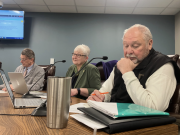









State Sen. Jana Hughes describes the challenges associated with a short legislative session. Parker Garlough
York News Times Reprint

Written by Parker Garlough
It’s been a frustrating session at the state Legislature, state Sen. Jana Hughes said at an event Friday morning.
Sponsored by the York County Farm Bureau, Hughes hosted a legislative update at the Dutch Kitchen in Henderson. About 20 constituents gathered to hear her speak and answer questions.
Addressing the budget shortfall
The state faces a projected deficit of $646 million, and legislators are scrambling to balance the budget. They must approve a budget proposal by March 25.
Hughes attributed the budget shortfall to a reduction in income tax. A 2023 bill was passed to reduce income taxes to 3.99% for the top two brackets by 2027, accelerating a tax reduction that had been voted in the year before.
“Every year that goes down, we lose $250 million in revenue, so that has not been helpful,” Hughes said.
She acknowledged some responsibility for the tax reduction, blaming inexperience.
“I was brand new,” Hughes said. “I was told it would be fine. There were some people saying, ‘This is not sustainable. We shouldn’t do that.’ I just didn’t know enough to listen.”
The Legislature’s current attempts to close the gap are shortsighted, Hughes said.
“Right now we’re doing a lot of moving money around,” Hughes said. “If you ask me, it’s a shell game. We’re just plugging holes with other money.”
That will cause issues in the future, she predicted.
“God only knows what we’ll be faced with next year or the year after,” Hughes said.
Hughes’ push to reduce sales tax exemptions
A more sustainable approach would be to increase revenue by removing sales tax exemptions, Hughes suggested. She sponsored a bill to remove exemptions for 20 items and services she considers luxuries, but it failed last-minute.
“Forty-five minutes before that vote took place last session, we had the votes to pass it … within the next 15 or 20 minutes, at least they had the guts to tell me, but a couple senators told me that they had switched their vote,” said Bruce Rieker, Nebraska Farm Bureau Federation vice president of government relations. “And I’m like, ‘You gotta be kidding me.’ No name was exchanged, but I know who was behind it. Somebody called them.”


Hughes and Rieker hinted that the caller was someone powerful in the state.
The opposition to new sales taxes comes from two directions.
“The Democrats will say it’s a regressive tax, because no matter how much income you have, you pay the same percent,” Hughes said.
There is also a significant contingent of Republicans who are opposed to all tax increases. Hughes criticized a group of state senators who pledged never to vote for a tax increase.
“Whoever’s going to take my spot in four years, don’t ever sign a pledge,” Hughes said. “Don’t ever put yourself in a corner. A true leader does not say ‘never.’”
Hughes has no intention of backing down from her stances on sales tax exemptions. Instead, she’s looking at more comprehensive solutions.


“I think what we really need next year is to start over,” Hughes said. “Put it out there: we’re going to sales tax everything, including groceries. Then, come to the table and peel off what we should not sales tax.”
She clarified that she is not advocating for the removal of all exemptions — rather, that they should all be reconsidered.
Taxing tobacco
Each member of the Legislature is expected to select one priority bill per legislative session. Hughes selected LB1124, a bill by state Sen. Tony Sorrentino to increase the tax on cigarettes from $0.64 per package to $1.64 per package.
The bill was filibustered and was two votes short of passing.
“There was over $300,000 spent from (tobacco companies) Altria and RJ Reynolds fighting this,” Hughes said. “They’ve had decades of experience fighting these things, and it worked. It was super frustrating.”
Excise taxes on tobacco products have been a priority for Hughes since she entered the Legislature. She sponsored a bill to include vaping products in an excise tax on tobacco products, taxing 5 cents per milliliter of fluid.
In hindsight, the tax should be based on a percentage of the price, not a set amount, Hughes said. She has since proposed multiple bills to make that change, but none have been successful.
“If I would have done my research, I would never agree to that,” Hughes said. “I want to do a wholesale percentage so as price goes up, it goes up, and you don’t have to mess with it again. That’s exactly what Big Tobacco doesn’t want to have happen. Because if you keep it at 5 cents, 20 years from now, 5 cents is nothing.”