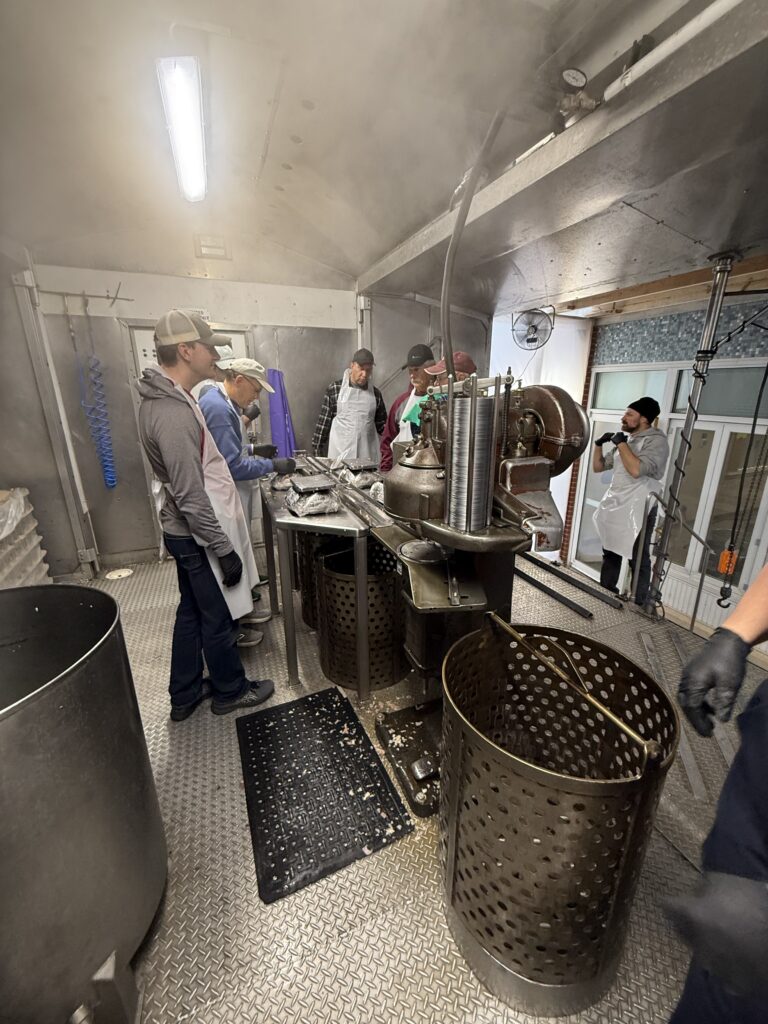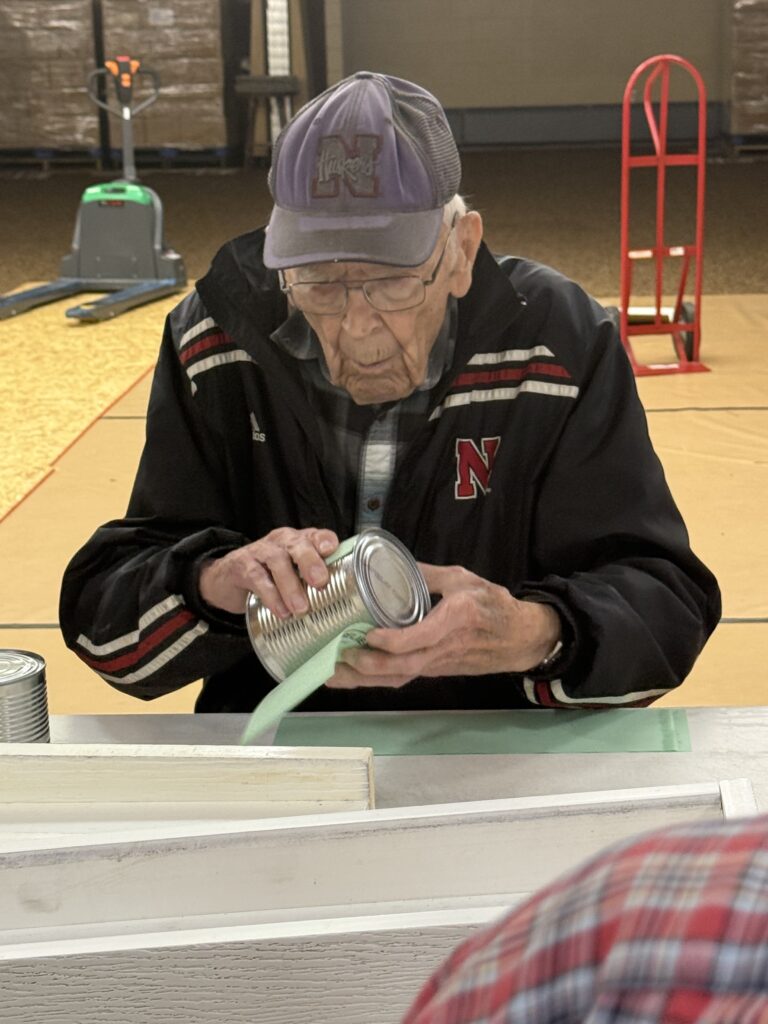
















An assembly line of volunteers wipes down the full cans of meat once they have been pressure-cooked – all photos courtesy Kerri Pankratz/Henderson News
Henderson News Reprint

Written by Kerri Pankratz
HENDERSON — The week of Thanksgiving began beneath an overcast and dreary sky. And while some headed off to work while calculating in the back of their minds how many turkeys would be required to feed a family gathering of say, thirty-three, folks in Henderson were grinding chicken and cleaning cans at Bethesda Mennonite Church because Thanksgiving week always means Canner Week in Henderson.
The Mennonite Central Committee “Canner Guys” rolled into town around the 13th of November with their mobile meat canner to set up at Bethesda, where canning was to take place on Friday, November 21, and Saturday, November 22, and again on Monday, November 24, and Tuesday, November 25. This cannery on wheels travels across the U.S. every year, stopping at various locations where volunteers gather to prepare cans of turkey, beef, chicken, and pork to be sent around the world. Over 30,000 people a year volunteer to fill, weigh, wash, and label every can.
The “Canner Guys”, along with transporting the necessary equipment from location to location, are also there to make sure everything runs smoothly. This year’s group includes Lars Braun of MacGregor, Manitoba, Canada; Kenan Broersma of Harlan, Kentucky; Thomas Carter of Honeoye Falls, New York, and Henderson’s own Matt Buller, who I’m sure is grateful this particular stop coincided with the Thanksgiving holiday.
Canner operators come from diverse backgrounds and sign on to two-year terms of traveling the country with the mobile meat canner. This year’s schedule includes stops in Ohio, Kansas, Nebraska, Oklahoma, Iowa, Illinois, Indiana, Pennsylvania, Virginia and New York. Henderson is, in fact, only the fifth stop of their 2025-26 Canning Season which started October 6 and will run through April 21.
There was a hum of activity upon entering the east office doors at Bethesda Mennonite Church on this particular Monday morning. The doors were marked with two bright pink signs that said: VISITOR’S ENTRANCE on them. The signs were surely placed there by a well-intentioned Canner organizer in hopes of directing volunteers from area churches to the Fellowship Hall where the hum was coming from. But once visitors entered through the doors no signs were necessary as they only had only to follow their noses to find the hub of activity. And no, they weren’t smelling unprocessed chicken; it was the delightful smell of homemade vegetable soup whipped up by the “Canner Kitchen Ladies” on a cold morning.
You see, there are perks to this volunteer job, and they include free food. Not only do the Kitchen Ladies provide two meals a day for all four days of the canner, but this day… this day was apple prieska day! The serving window was overflowing with homemade prieska much to the delight of many. One particular out-of-town volunteer had even called to find out which day apple prieska would be served so that he could plan his volunteer hours accordingly.
The Fellowship Hall was set up with two long rows of tables where groups of plastic-aproned men were scattered about enjoying their morning coffee. Many of them had been at church since 6:00 a.m. when they assisted in processing the first batch of chunked chicken thighs of the day.
There was currently a lull in the action as more guys and some gals (I saw you, Wendy) were all aproned up and topped off with the necessary seed corn cap on their heads, waiting to get another run underway.
In another area of the room, volunteers were working on emptying out a giant container of chicken thighs onto a large table, where they would eventually end up being fed through a grinder by yet another volunteer.
The 26,000 pounds of chicken that are being canned this year all have to be ground down into 1-inch chunks because “the weight is actually critical for the canning process,” stated Canner organizer JayDee Janzen. “The worst job of all is actually hauling that giant tub of ground chicken out and up into the truck,” he stated. It’s definitely a two-man operation.
Out in the truck, around six to eight guys use individual scales to measure the correct amount of meat into each empty can. The cans then go through the can sealer and get a lid, and then into the giant pressure cookers to be processed.
The giant baskets of metal cans, now filled with meat, then go through a second assembly line where each can is wiped down, weighed once again, and then receives a numbered green label and is packed into a box to “marinate”, or cure, until it’s time to be shipped out.
The second assembly line of wipers and labelers was made up of men and women of all ages, with the youngest being little Mila Schmucker, all of three years old, and the oldest being RaGene Ratzlaff at 91. Heartland FFA Advisor and Ag Instructor Stephanie Miller also brought her ag classes in on Monday to help out for the afternoon.
On Friday alone, the group canned 4,480 cans of chicken thighs and then repeated the process during the next three days for a total of just under 18,000 cans.
Between April 2024 and March 2025, MCC partner churches and organizations, which are located throughout Ukraine, received 72,000 cans of meat. This supply was part of 611,520 cans of meat that volunteers in the U.S. donated and preserved for people in crisis throughout the world… and just think of it, 18,000 of those cans of meat were processed in a town of about a thousand people… right here in Nebraska.