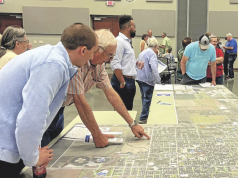




















Jason Stephens, who owns the Henderson Foodmart, spoke to about 40 community members who showed up on Thursday night.

Written by Kerri Pankratz Henderson News, and Shannon Siebert Heartlandbeat
If you happened to stop by the Henderson Foodmart on Thursday, October 23, there was a sign posted on the front door that said Jason (Jason Stephens, the owner of HFM) would be holding a public meeting at 7 p.m. in the back of the store.
Not many folks are stopping by HFM these days since the shelves are empty and there is little to purchase in the way of groceries, produce, or meat.
But word spread, and around 40 community members showed up.
Clearly, Stephens didn’t expect this kind of a showing and said he thought about five or six would show up. Heather Chase, who works at the Dutch Kitchen, quickly arranged for the meeting to be held in the back room at the Dutch Kitchen.
Tanya Leazer, an HFM manager, introduced owner Jason Stephens, and the meeting began.
“I wanted to meet and talk about how we got here and what the process has been. By mid-December last year, we were fully transitioned in the purchase of the store,” said Stephens. He then tried to explain how he encountered obstacles in working with the AWG warehouse and why truck deliveries stopped in January of 2025.
His explanation was confusing, but basically, he and AWG couldn’t agree on whether he had enough “stock” to order a truck. “I would have to prepay $20,000 to $30,000 to get a truck, so I had to rob Peter to pay Paul.”
Stephens owns several other grocery stores in Nebraska and Kansas, and explained the problems he was having with the one he had purchased about the same time as the HFM in Erie, Kansas.
Stephens’ company signed a one-year lease to run the grocery store in Erie. The City of Erie was in the process of buying the store from the previous owners, but at a point, it quit paying the prior owners. This was not disclosed to Stephens. The prior owners then sued the City of Erie and Stephens decided to get out of the entire situation.
Stephens then notified AWG that he was not moving forward with the Erie store purchase but wanted that store’s stock repurchased and transferred to a holding company. It wasn’t until he was unable to secure trucks for the HFM store, due to “not having enough stock” according to AWG, that he found out the City of Erie cashed out all of his stock. Thereby, depleting the stock necessary to enable him to order product for the HFM store.
“The city of Henderson does not deserve this. This is 100% not anybody’s fault, but I should have caught that,” said Stephens, “But nowhere in my brain did I think that when they said I didn’t have enough stock, that I should have gone and checked another store.”
He is currently in litigation with the city of Erie.
“It’s completely unacceptable,” said Stephens, “but at the end of the day I’m doing everything I can do to try to keep this thing going.”
Tensions were high among the crowd, and those attending the meeting began firing questions and comments after he offered excuses for the grocery store’s poor condition. No one was in the mood for excuses.
“My son was on the loan committee that decided to loan you the $250,000 from Mainstay Communications. He told me this guy has a great plan, and he voted to give you the loan. He regrets it now. You should be held accountable for paying back this loan because you have shown no promise running HFM as a business, and I personally don’t think you can do it,” said Lowell Hiebner.
Mainstay Communications has access to USDA funds through the Rural Economic Development Loans and Grants (REDL&G) program. In the past, they have utilized it to loan money to the City of Henderson and Henderson Health Care. It’s not an easy or quick process to go through to qualify for one of these low-interest loans, according to Mainstay Director Jeremiah Duerksen. The program is not just for nonprofits; it can also support economic development and job creation.
When asked about the $250,000 loan, he said he used it to purchase the store’s inventory and equipment from the investors who sold it. It was reported back in December that Stephens did not buy the building from the investors.
He was then asked whether he ran his other stores this way, and he replied, “No.” But someone said they had heard his store in Blue Hill had the same low stock problems. He said it was not the same scenario.
“I have a question,” said Sheree Goertzen, “So what does this mean for Henderson Foodmart? Does that mean we will continue to be in this lurch, where we don’t have any food on the shelves and we can’t count on anything? What are your thoughts on solving this problem?”
“Because if you’re waiting for a lawsuit to go through, that’s going to take a long time to take care of,” remarked a member of the crowd.
“The lawsuit has nothing to do with that. I’m working on some avenues,” he said.
The crowd continued to demand to know what specifically he was doing to remedy the situation, and he declined to offer any details. Later in the meeting, he said he would have a plan in place by next Thursday.
This solution was only offered after Goertzen asked for some kind of timeline. “Is there a point in which you’re willing to say ‘I want to give up the grocery store and sell it?’ We need some kind of framework in which we can hold you accountable. I don’t think you were expecting this today. This is a lot to take in. So thank you for taking the time…”
“I thought maybe five people would be here.” Stephens repeated for the third time.
“I know,” said Goertzen, “We need a plan, and we need to see something. We don’t trust you at this point. You have to rebuild our trust. So we need to see some change at the grocery store.”
Below are some of the comments made by those present at the meeting:
“I run a daycare business with ten kids, and I can’t just jump in the car and run to York when I need food or other supplies.”
*We have a lot of elderly folks who can’t drive to York and rely heavily on a local store.”
“We’ve had six funerals at our church this month, and we’ve had to eventually go to the Aurora Mall to feed everybody at the luncheons because you guys just don’t have it anymore, and there’s no assurance that you will get it.”
“I just think you need to know the impact you’ve had on this community,” stated Kendra Switzer, “I mean, the elderly people, the churches, the schools, the other restaurants, I mean, it has trickled way down.”
“I have always tried to do as much grocery shopping as possible in town,” said Jen Hiebner, “but I also shop for our school’s backpack program, which is every other week, we send bags of food home. Bethesda Church is the church that sponsors the backpacks, and I do the shopping for it. I haven’t been able to buy at the grocery store here in town because I have to buy 11 of everything I buy, and there has not been enough on the shelves. And it’s all non-perishable items. I would love to support the grocery store and be able to do it there but every time I’m in there there’s like three boxes of an item and not enough canned food. What can we expect or when can we expect that to be remedied?”
“Why do you continue to run a business where you can’t sell anything? I’ve run a business for forty years, and if I don’t have anything to sell, I’d better close my doors,” stated Mary Buller. “Plus, you had all that inventory. As I understand, there was a very large inventory when you bought it, so you’ve taken all that cash in. Where did all that cash go?”
“We have holidays coming up and we are fed up!”
“We need the whole works back in the store, not just canned goods, but produce and meat. It’s all or nothing,” said Carol Janzen.
The meeting ended around 7:45 p.m., leaving everyone who attended with more questions than answers. As Stephens said, “The city of Henderson does not deserve this.” This meeting indicated the need to present more information to the public, not only from Stephens but also from the investors who sold the grocery store, and to discuss how this dilemma might be solved.
We will keep you posted if any new information becomes available by next Thursday.