

























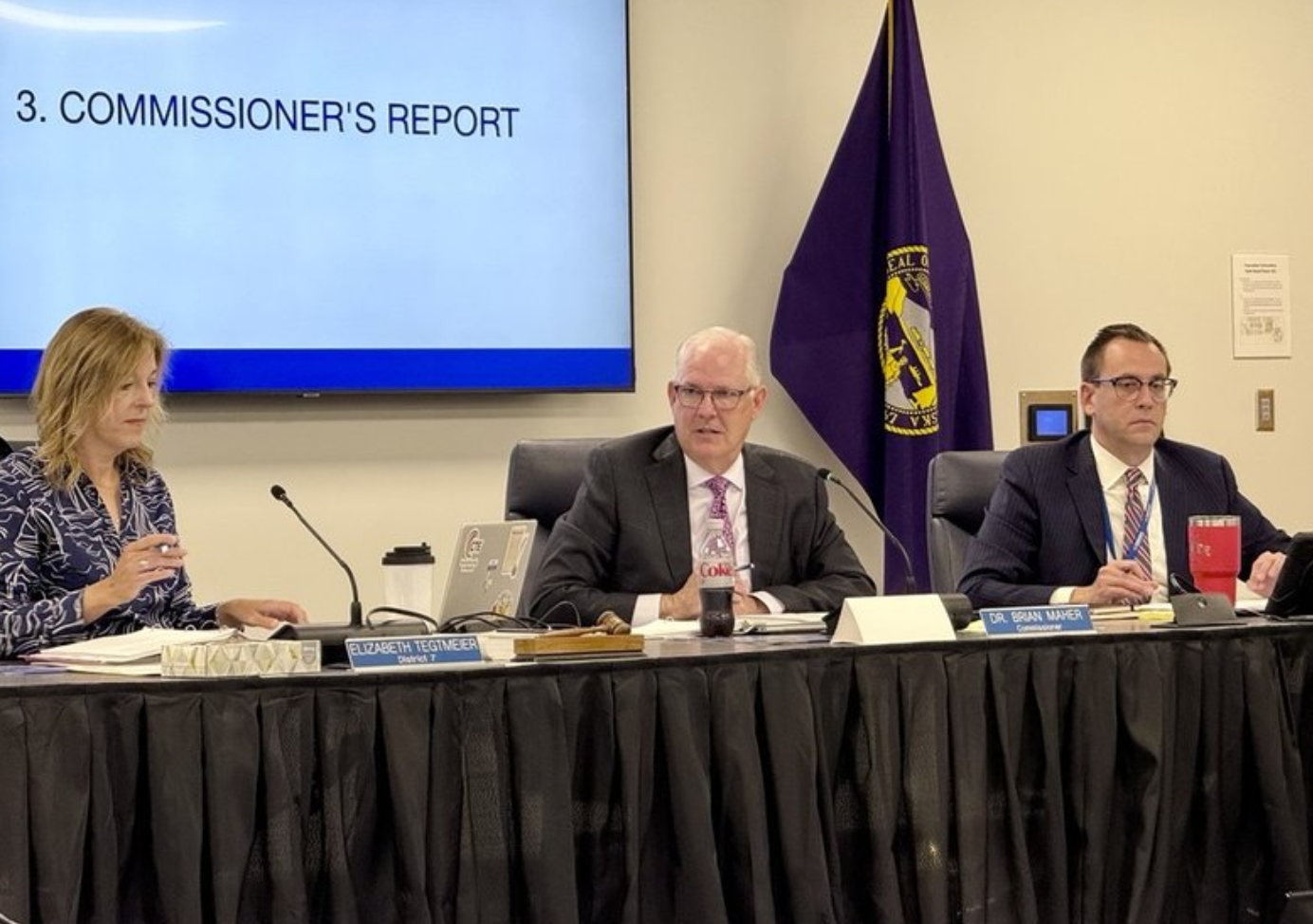
Nebraska Department of Education Commissioner Brian Maher provides updates at the June 2025 State Board of Education meeting. (Photo by Jolie Peal/Nebraska Public Media News)

Written By Jolie Peal
Students’ scores in reading, science and math barely budged for the 2025-26 school year compared to the previous year on the Nebraska Student-Centered Assessment System, or NSCAS.
The Nebraska Department of Education released testing and demographic data for the 2025-26 school year on Wednesday. Students in grades 3-8 take the test for English language arts and math, with students in fifth and eighth grades also taking the science assessment. All high school juniors across the state take the ACT or a state equivalent.
In both English language arts and math, there was a 0.25 percentage point increase in students considered proficient compared to the previous school year. In science, there was a 0.04 percentage point gain.
High school juniors saw a more than 2 percentage point increase in ELA proficiency reaching almost 45%, and a roughly 5 percentage point increase in both math and science for about 46% and nearly 53% proficiency respectively.
NDE Commissioner Brian Maher told reporters Wednesday that after a small decline last year, ELA scores on the NSCAS bounced back and are now the highest proficiency rate since the state moved to this assessment in 2017. Also, ELA and science scores on the state assessment along with math and science scores for the ACT are at their highest levels since the pandemic.
“These results reflect the hard work of Nebraska students, absolutely, the teachers who are in our classrooms, school leaders, and families, as well as the impact of ongoing efforts to support student learning across our state,” Maher said.
NDE has focused on improving reading scores in schools in its strategic plan, with specific goals to see 75% of third graders proficient by 2030 and 73% of high school juniors. Maher said while that work isn’t done, he expects to see the state improve at an accelerated rate.
“We’ve built this huge snowball, and we need some momentum to move that snowball forward, and we’re beginning to see that move forward,” Maher said. “The improvement, the trend line that we see this year, gives us a real reason for optimism.”
There are also goals to improve mathematics to 80% of eighth graders being proficient and 71% of 11th graders.
The state also wants to reduce chronic absenteeism to 11% by 2030. Chronic absenteeism is when a student misses 10% or more of school.
The data for the 2025-26 school year shows that was another area that stayed roughly the same with a less than 1 percentage point improvement. It went from 19.38% in the 2024-25 school year to 18.83% in the 2025-26 school year.
Maher said this is a significant reduction from the 22% chronic absenteeism rate the state saw five years ago, following the COVID-19 pandemic.
A 2025 report from the Nebraska Statewide Workforce and Educational Reporting System (NSWERS) showed a potential link between students who are chronically absent and lower test scores.
There was also a drop in overall enrollment of almost 2,000 students across the state last school year, which matches a national trend schools are seeing.
By way of full disclosure, Brian Maher is a commissioner on Nebraska Public Media’s governing board, the Nebraska Educational Telecommunications Commission.